Canada Affected Country 3D Map: A Strategic Visual Tool for Pandemic Data Communication
In the landscape of digital communication, particularly during global health crises, the ability to convey complex statistical data quickly and accurately is paramount. The Canada Affected Country 3D Map represents a specific approach to visualizing pandemic metrics, moving beyond traditional flat charts to offer a spatial representation of the crisis. This design template is not merely an aesthetic choice; it serves as a functional resource for researchers, public health officials, and content creators who need to illustrate the scope of the Coronavirus outbreak with depth and clarity.
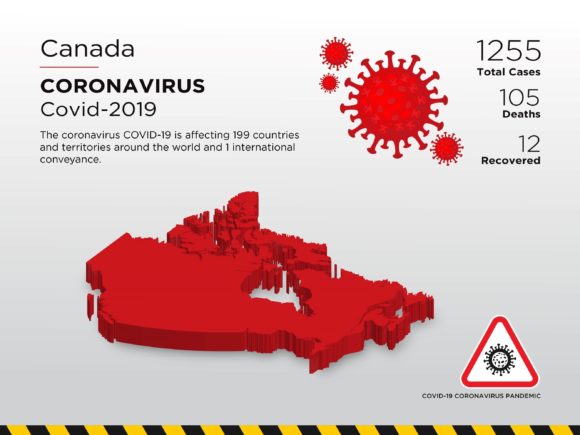
When evaluating data visualization tools, one must consider how effectively they translate raw numbers into actionable insights. The Canada Affected Country 3D Map utilizes three-dimensional modeling to highlight affected regions, making the severity of the situation more tangible to the audience. Unlike standard 2D infographics that rely on color gradients alone, this 3D approach adds a layer of realism that can enhance engagement on social media platforms and in professional presentations.
Distinguishing Features of the 3D Visualization Approach
The primary distinction of the Canada Affected Country 3D Map lies in its dimensionality. Traditional maps often flatten the geography, which can sometimes obscure the relative scale of infection rates between different provinces or territories. By employing a 3D vector flat illustration style, the design emphasizes verticality. This allows designers to represent "Total Cases," "Deaths," and "Recovered" populations as physical structures rising from the map's surface.
This method offers several distinct advantages:
- Spatial Context: It provides a clearer understanding of geographic distribution, helping viewers visualize the spread across the vast Canadian landscape.
- Visual Impact: In a crowded digital feed, a 3D element naturally draws the eye more effectively than a static 2D chart, increasing the likelihood of user interaction.
- Narrative Depth: The depth of the map allows for a layered storytelling approach, where quarantine zones or high-risk areas can be visually elevated to signify urgency.
Furthermore, the inclusion of specific elements like quarantine icons and stay-at-home messaging within the 3D framework ensures that the design remains educational rather than purely decorative. The Global pandemic vector flat illustration component complements the map by providing a consistent stylistic language that unifies the infographic, ensuring that the message about the coronavirus outbreak is cohesive.
Comparing 3D Maps to Alternative Design Formats
Selecting the right infographic template depends heavily on the intended medium and the specific goals of the campaign. When comparing the Canada Affected Country 3D Map to other common formats, such as flat line graphs, pie charts, or standard 2D heat maps, distinct tradeoffs emerge.
Flat Infographics vs. 3D Representations
Flat infographics are excellent for quick consumption and printing. They are lightweight, load faster on mobile devices, and are often easier to read at small sizes. However, they can lack the emotional resonance required to drive home the gravity of a pandemic. The Coronavirus Post Infographics Design template utilizing 3D mapping addresses this by adding a sense of volume and presence. While a flat map might show a red dot over Ontario, a 3D map can show a towering structure representing thousands of cases, creating a visceral reaction in the viewer.
Data Density and Clarity
A potential limitation of any 3D design is the risk of visual clutter. If too much data is crammed into the three-dimensional space, the message can become confusing. In contrast, a well-designed 2D table or list might present the exact same data with greater precision. The Canada Affected Country 3D Map strikes a balance by using vector graphics, which remain crisp at various resolutions, but it requires careful curation of data points to ensure readability.
Social Media Optimization
For social media banners, the aspect ratio and visual hierarchy are critical. The Covid-19 outbreak, pandemic poster design capabilities of this template are specifically tailored for these environments. Social users scroll quickly; a 3D element acts as a visual anchor. Compared to text-heavy posts, the Canada Affected Country 3D Map communicates the core message—cases, deaths, and recoveries—in seconds. However, for detailed analytical reports intended for academic or policy-making audiences, a traditional spreadsheet or a series of 2D bar charts might still be the superior choice for granular analysis.
Evaluating Strengths and Tradeoffs for Decision Makers
Choosing the right resource involves understanding the strengths and limitations of the tool. The Canada Affected Country 3D Map excels in scenarios requiring high engagement and broad awareness. Its strength lies in its ability to synthesize complex statistics into a single, powerful image.
Key Strengths
- Versatility: The included files (EPS and JPEG) allow for use in both print media (posters, flyers) and digital platforms (web banners, social media posts).
- Scalability: Being a vector-based design, the map can be resized without losing quality, making it suitable for everything from a smartphone screen to a large conference display.
- Thematic Consistency: The integration of quarantine and stay-at-home concepts ensures the design aligns with current public health messaging standards.
Potential Limitations
While visually striking, 3D designs can sometimes sacrifice precise data accuracy for aesthetic appeal. Viewers may focus on the height of the 3D bars rather than reading the specific numbers associated with them. Additionally, accessibility can be a concern; individuals with certain types of color blindness or visual processing difficulties might find 3D shading harder to interpret than high-contrast 2D charts. Therefore, it is advisable to accompany the Coronavirus Infographics Design Template with clear textual captions or alt-text descriptions.
Strategic Use Cases and Best-Fit Scenarios
To determine if the Canada Affected Country 3D Map is the right choice for your project, consider the specific context of your communication strategy.
Ideal Applications
This design is best suited for social media post banner design campaigns aimed at raising general awareness. Public health organizations, news outlets, and community groups looking to share daily updates on total cases, deaths, and recovered peoples will find this format highly effective. The 3D element serves as a hook to stop the scroll, while the embedded data provides the necessary information.
It is also valuable for Quarantine, stay at home, coronavirus Covid-19 banner design concept initiatives. By visually elevating the concept of containment, the map reinforces the importance of following safety protocols. For example, a 3D map showing a spike in cases in a specific region can be paired with localized advice on quarantine measures, making the warning feel immediate and relevant.
When to Consider Alternatives
If the goal is to provide a deep dive into epidemiological trends over time, a dynamic interactive dashboard or a series of 2D trend lines would be more appropriate. Similarly, for internal strategic planning where exact numerical precision is non-negotiable, raw data tables should take precedence over illustrative maps. The Canada Affected Country 3D Map is a communication tool, not a data analysis engine. It is designed to inform and persuade, not to replace rigorous statistical review.
Making an Informed Choice for Your Content Strategy
Ultimately, the decision to utilize the Canada Affected Country 3D Map hinges on the need for visual impact versus data granularity. For professionals aged 20–50 who are navigating the complexities of digital content creation, having access to versatile templates like this Global pandemic vector flat illustration set is invaluable.
The availability of both EPS and JPEG formats ensures that the asset fits seamlessly into diverse workflows. Whether you are designing a Covid-19 outbreak, pandemic poster design for a local clinic or a social media post banner design for a national advocacy group, the 3D map offers a modern, engaging solution. It transforms dry statistics into a compelling narrative that resonates with the public.
By weighing the benefits of enhanced visual engagement against the need for precise data presentation, stakeholders can make informed decisions. If the objective is to capture attention, simplify complex information, and encourage compliance with health guidelines, the Canada Affected Country 3D Map stands out as a robust option. However, it should always be part of a broader strategy that includes accurate data sourcing and accessible design practices.
In conclusion, the Coronavirus Post Infographics Design template featuring the 3D map is a practical resource for the modern digital age. It bridges the gap between technical data and public understanding, offering a clear, impactful way to communicate the realities of the pandemic. As the world continues to adapt to new health challenges, having high-quality, adaptable visual tools remains essential for effective communication.